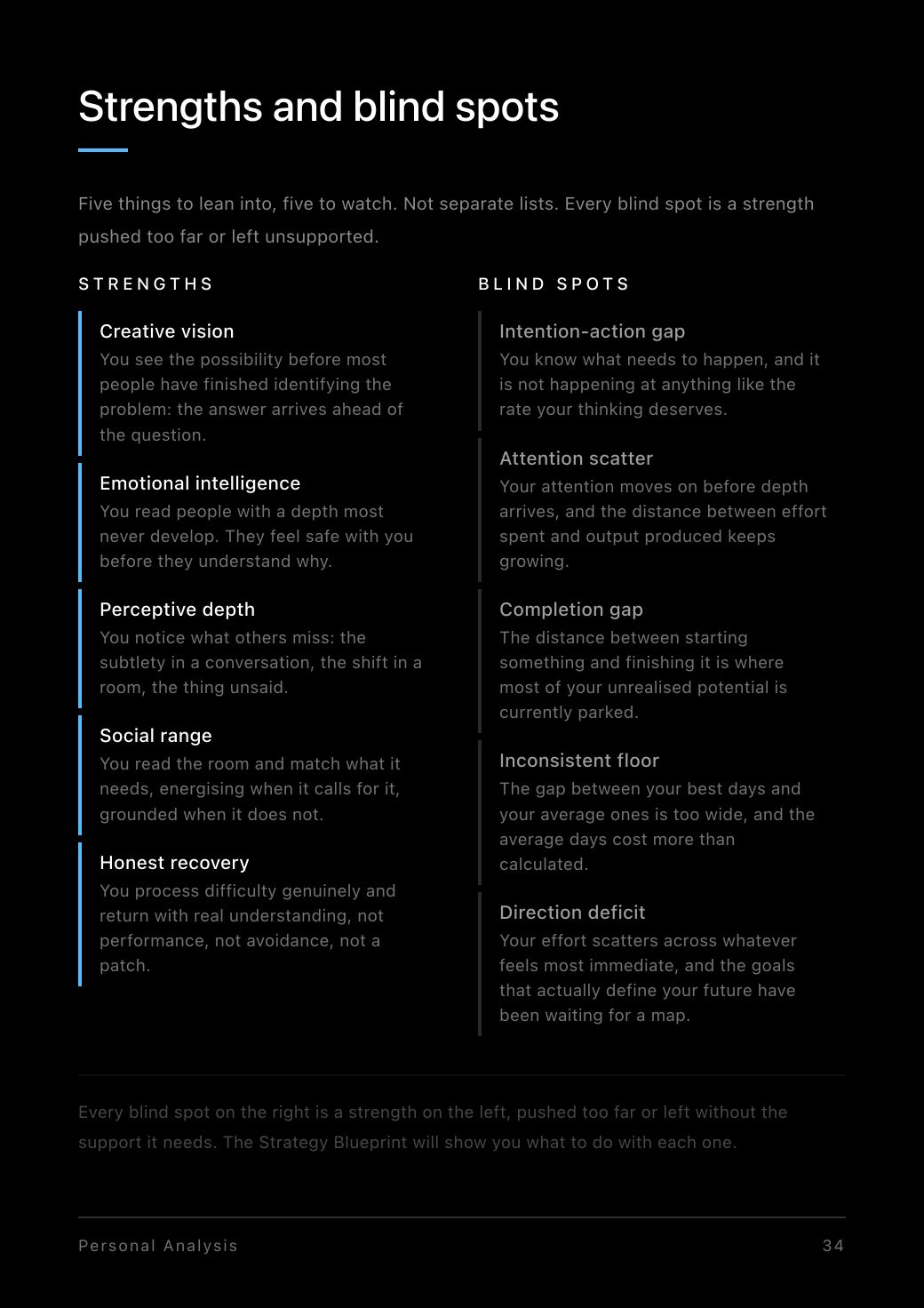
Discover your strengths and blind spots
Know where your strengths give you an advantage and where a little support makes the difference.
Discover your strengths and blind spots
Use your strengths. Give your blind spots the support they need.
Discover your strengths and weaknesses, understand what shapes your actions, and build a plan to reach your goals.

“Knowing yourself is clarity. Mastering yourself is power.”
Self knowledge you can put to work.
Personal Blueprint brings self understanding and personal development together. It helps you analyse your strengths, understand your weaknesses, and recognise the patterns that shape your daily decisions, giving you greater clarity to make better decisions for yourself.
That knowledge and insight will allow you to choose meaningful priorities, turn failures into insight, and create a plan tailored to you and your goals. With this clear starting point, you can build your own system for making progress you can see, turning your goals into success without having to start over.
Average customer rating
People building their future
Accuracy
Personalised results
A clearer picture of you. A practical way forward.
Know where your strengths give you an advantage and where a little support makes the difference.
Use your strengths. Give your blind spots the support they need.

Choose the priority that matters most. Give your effort a clear, manageable first step.
Keep what works, adjust what doesn’t, and return to a clear plan when your momentum fades.

See which actions move you forward, so you can build on evidence rather than guesswork.
Find a meaningful priority and a manageable first move. Give your effort a clear direction.

Separate what went wrong from who you are. Use the lesson to improve your next attempt.
See how your traits and habits influence each other so everyday struggles start to make sense.

Connect your traits, strengths and reactions. Understand what shapes the way you think, feel and act.

Recognise what triggers a familiar pattern. Practise a different response and find a new way forward.

Turn your traits and priorities into practical steps that fit the way you work.
Build around who you are. Make the next step clear.

Recognise what matters most. Let your priorities guide your choices instead of pressure or impulse.

Ask better questions, learn from your choices, and guide your next move with greater clarity.
Use a repeatable way to reflect, choose, and act as your goals and circumstances change.
One connected experience
100 questions exploring your personality, habits, and approach to taking action.
A detailed reading of your ten core traits and the patterns they reveal.

Guidance for translating self knowledge into goals, plans, and habits.
Practical worksheets for your priorities, next steps, and progress.
From personal insight to real progress
Understand your strengths, blind spots, and patterns so you know what to build on and what to change.
See your ten traits together. Recognise where to use your strengths and where more support could help.
Learn each trait’s meaning, strengths, and everyday influence so you can work with your tendencies more deliberately.
Recognise your traits at work, in relationships, and in habits. See when a strength becomes a blind spot.
Understand what makes follow through difficult. Replace self blame with a clearer view of the support you need.
Turn personal insight into a clear direction, practical steps, and habits that support the future you want.
Make your goal clear enough to guide your choices and give today a useful next step.
Use guidance shaped by your results. Build practical support around how you think and follow through.
Choose an approach that fits you, with practical steps that work towards the same goal.
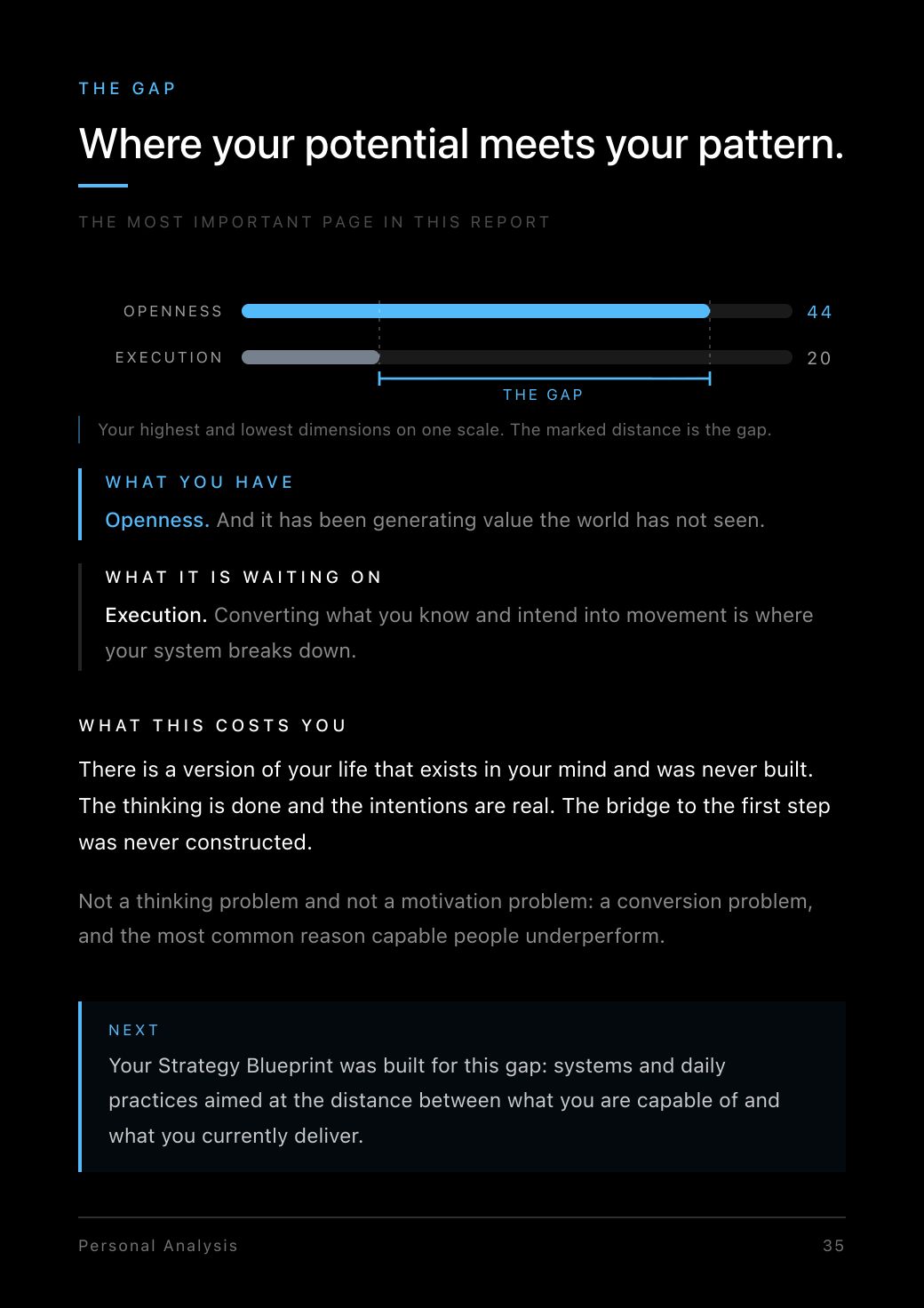
Find the missing step between wanting a result and taking action so good intentions become a workable plan.
See how your traits interact, why obstacles repeat, and which responses could help you move forward.
Connect all ten traits into one clear portrait of how you think, feel, and act.
Put your strongest qualities to work and support your blind spots, without trying to change everything at once.
Find what holds your strengths back and choose a meaningful starting point for change.
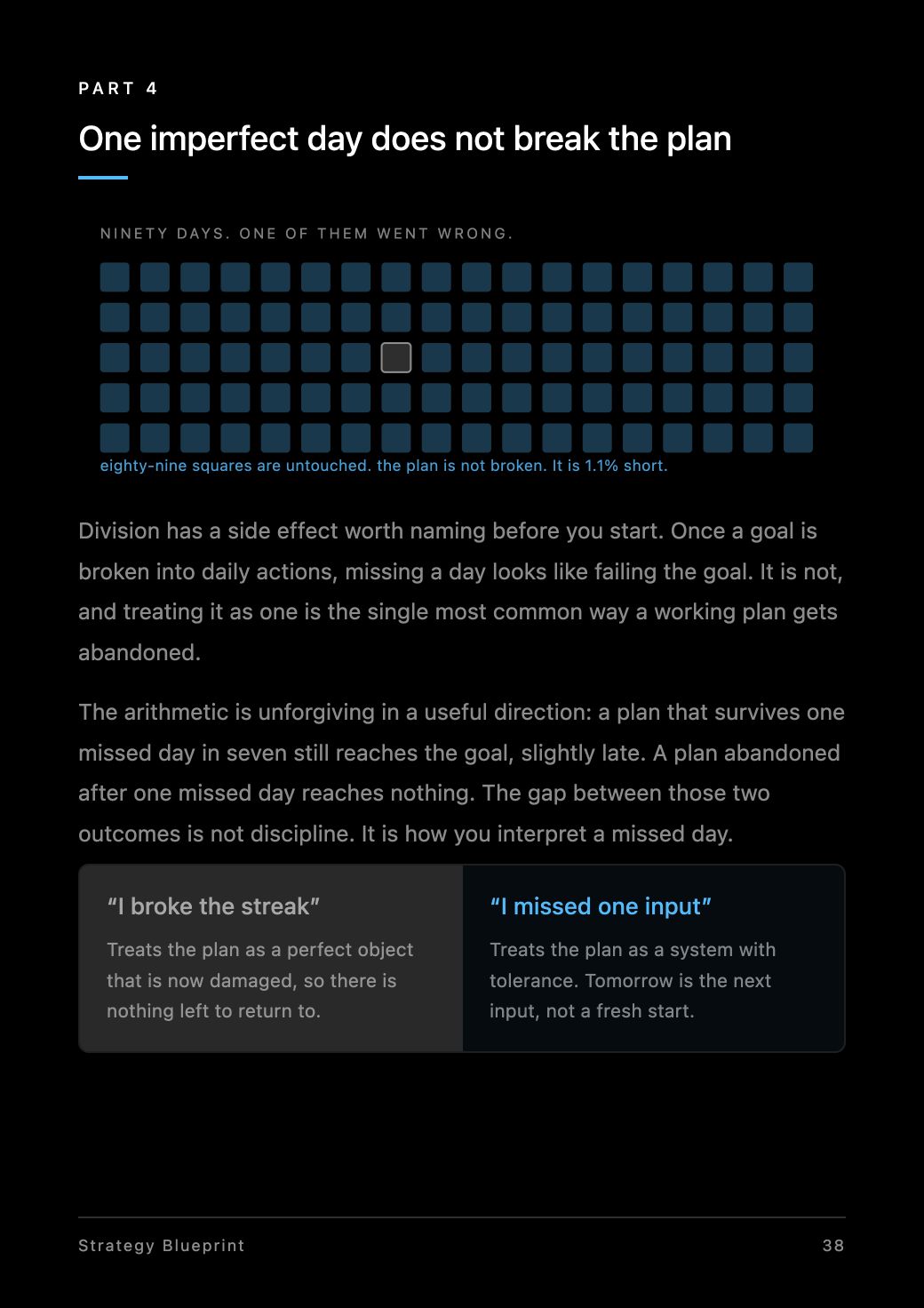
Build a way back after setbacks, so one missed day doesn’t mean starting over.
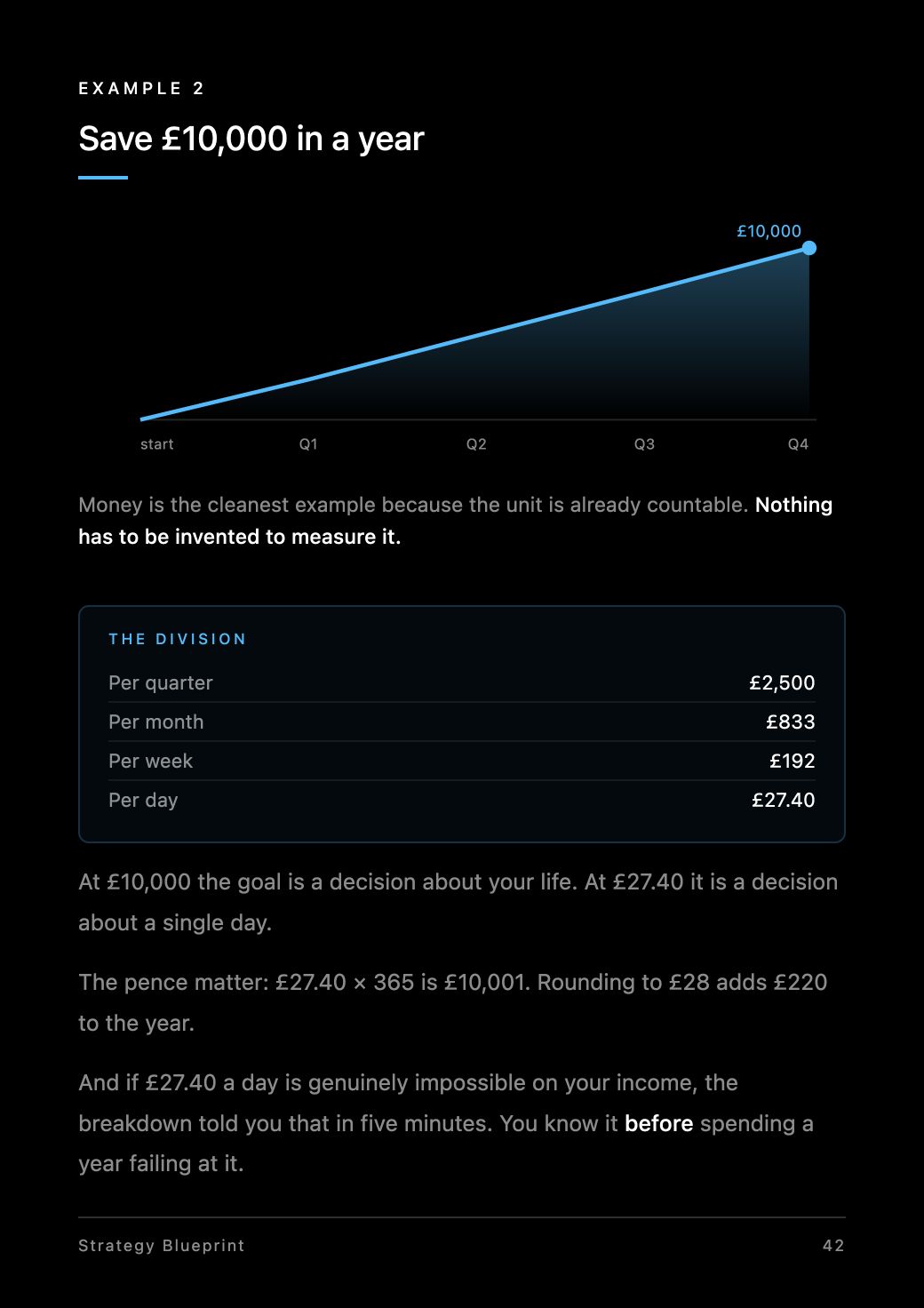
Break a distant goal into realistic, measurable steps and know what to do next.
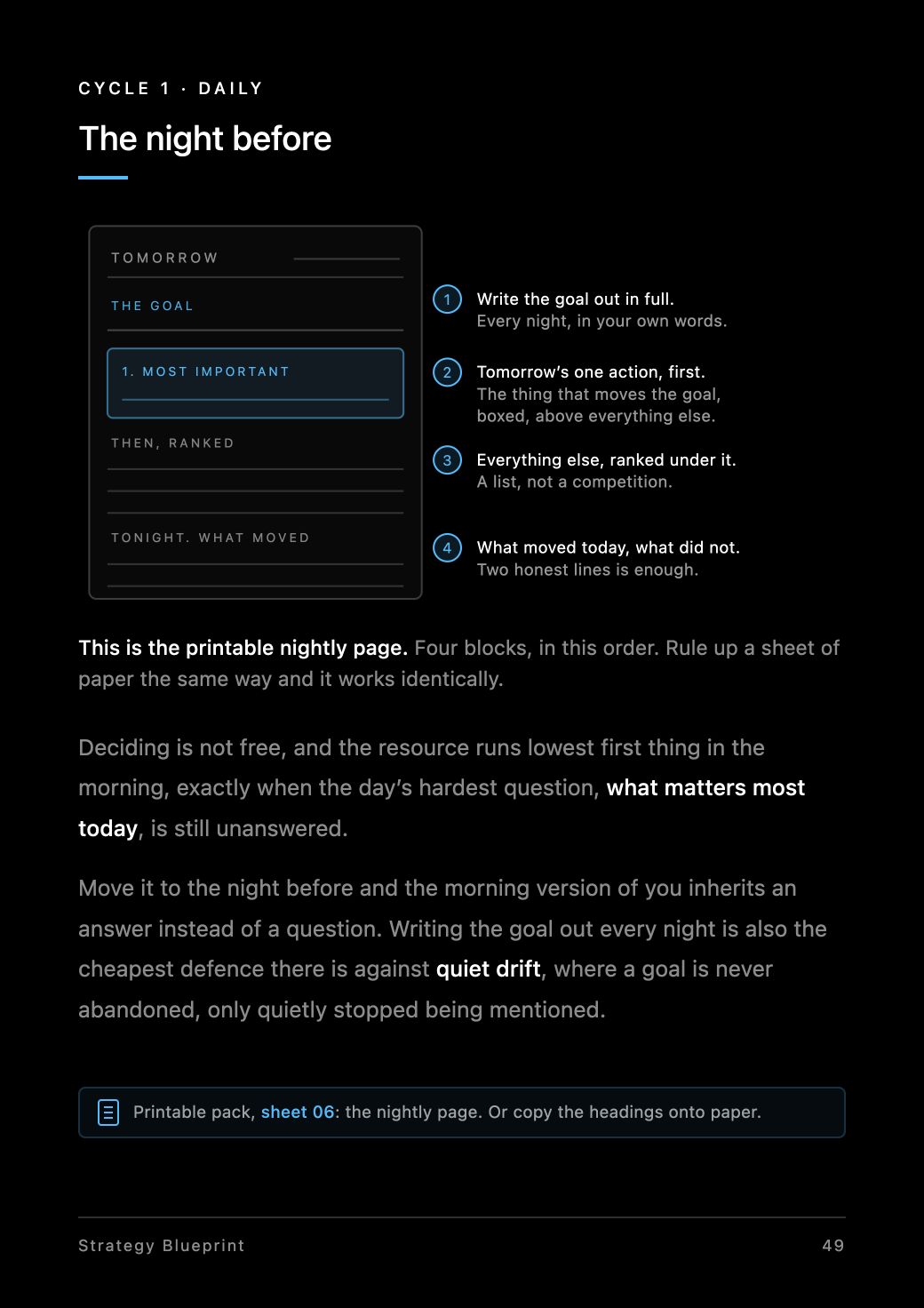
Choose tomorrow’s priority tonight. Spend less energy deciding and more on the action that matters.
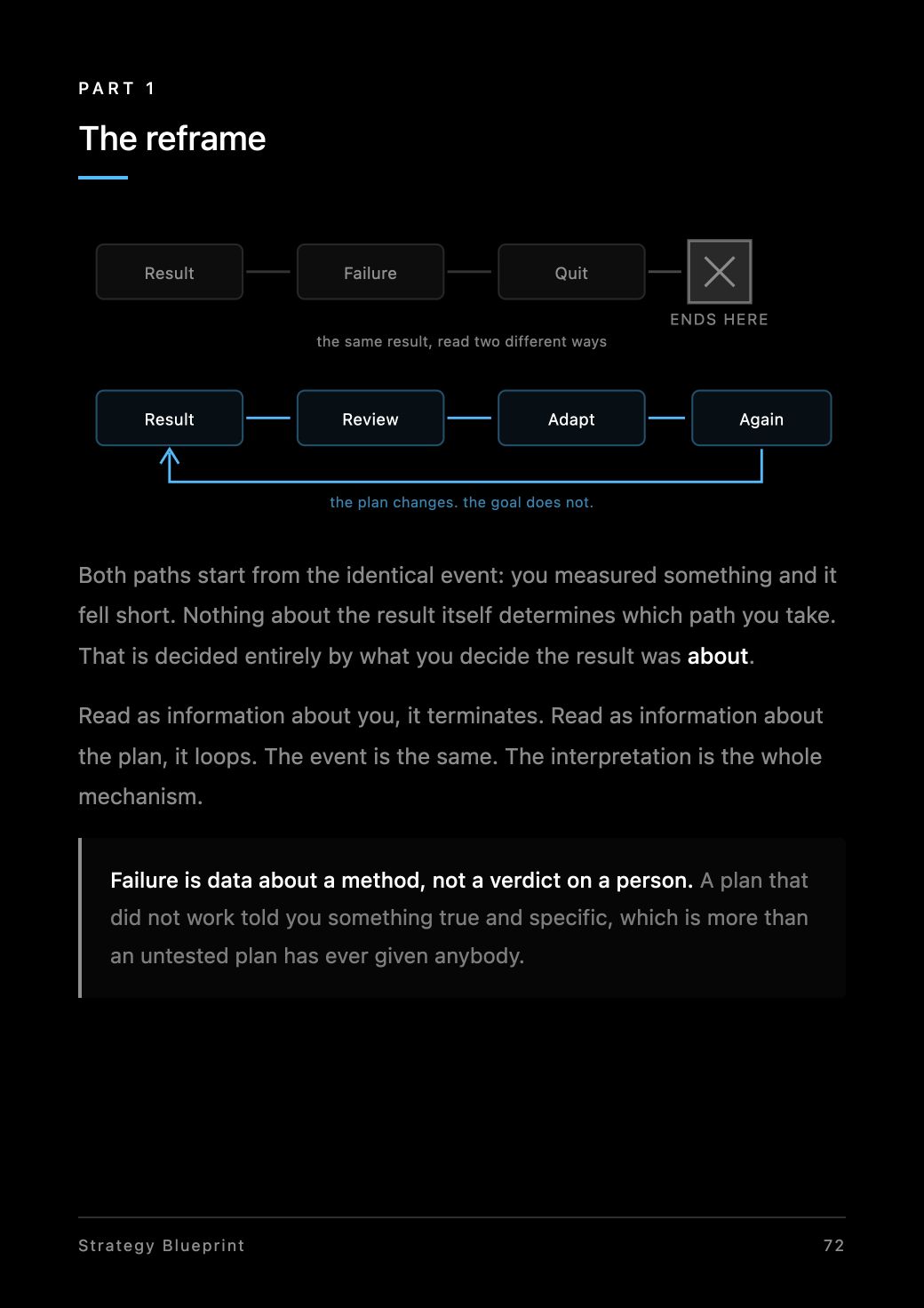
Treat setbacks as information, not a judgement of yourself. Adjust your plan and make a better informed next attempt.
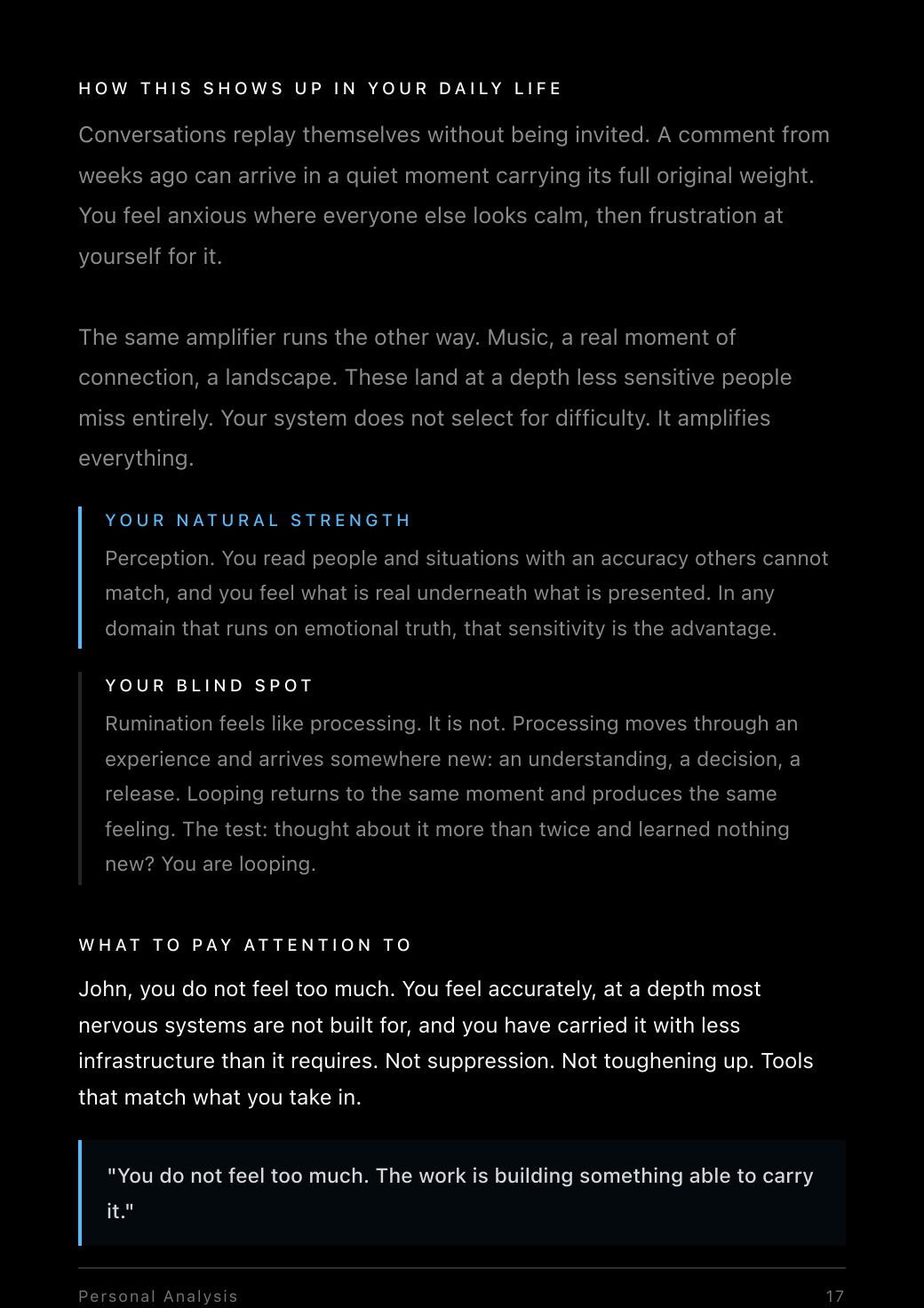
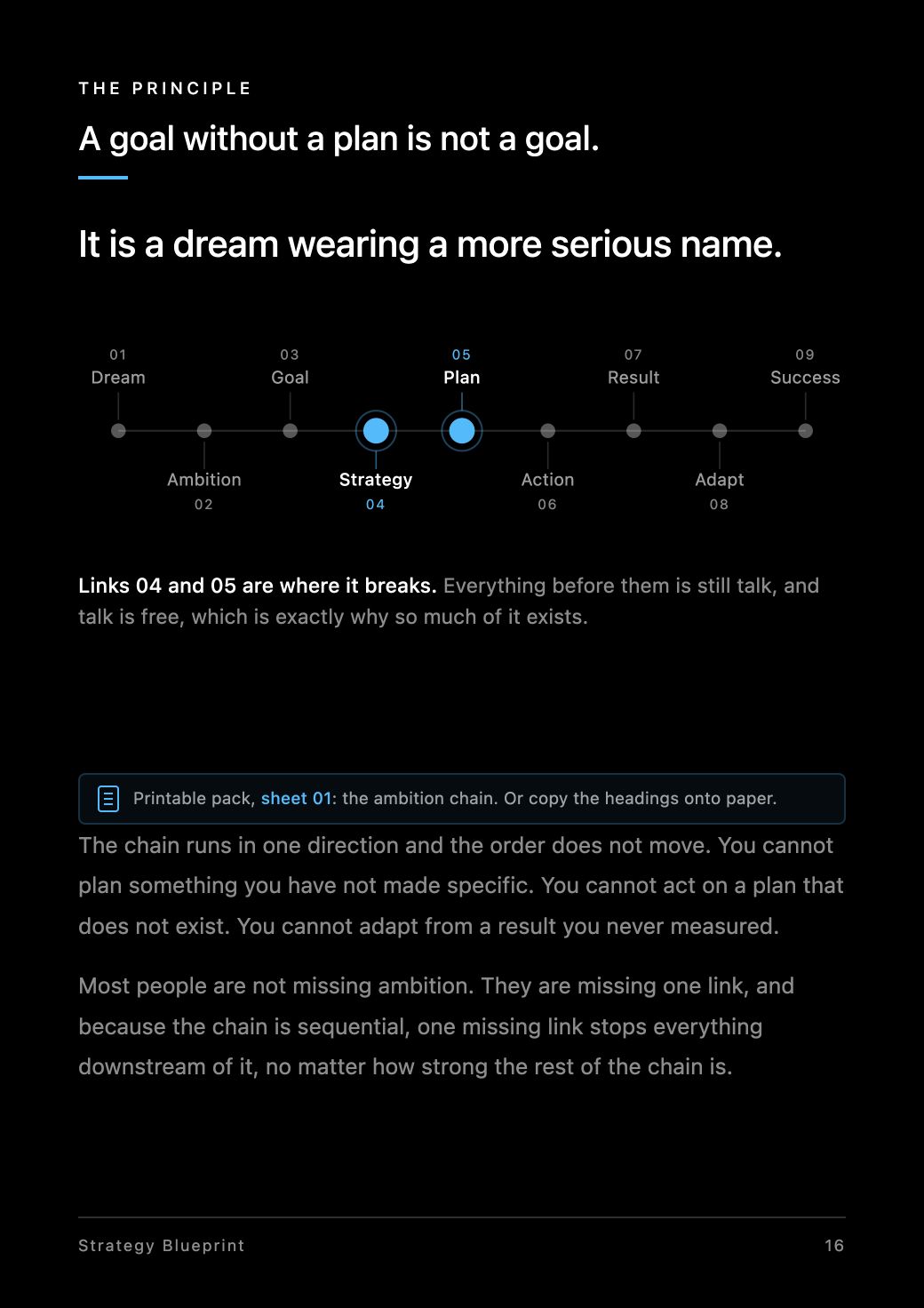
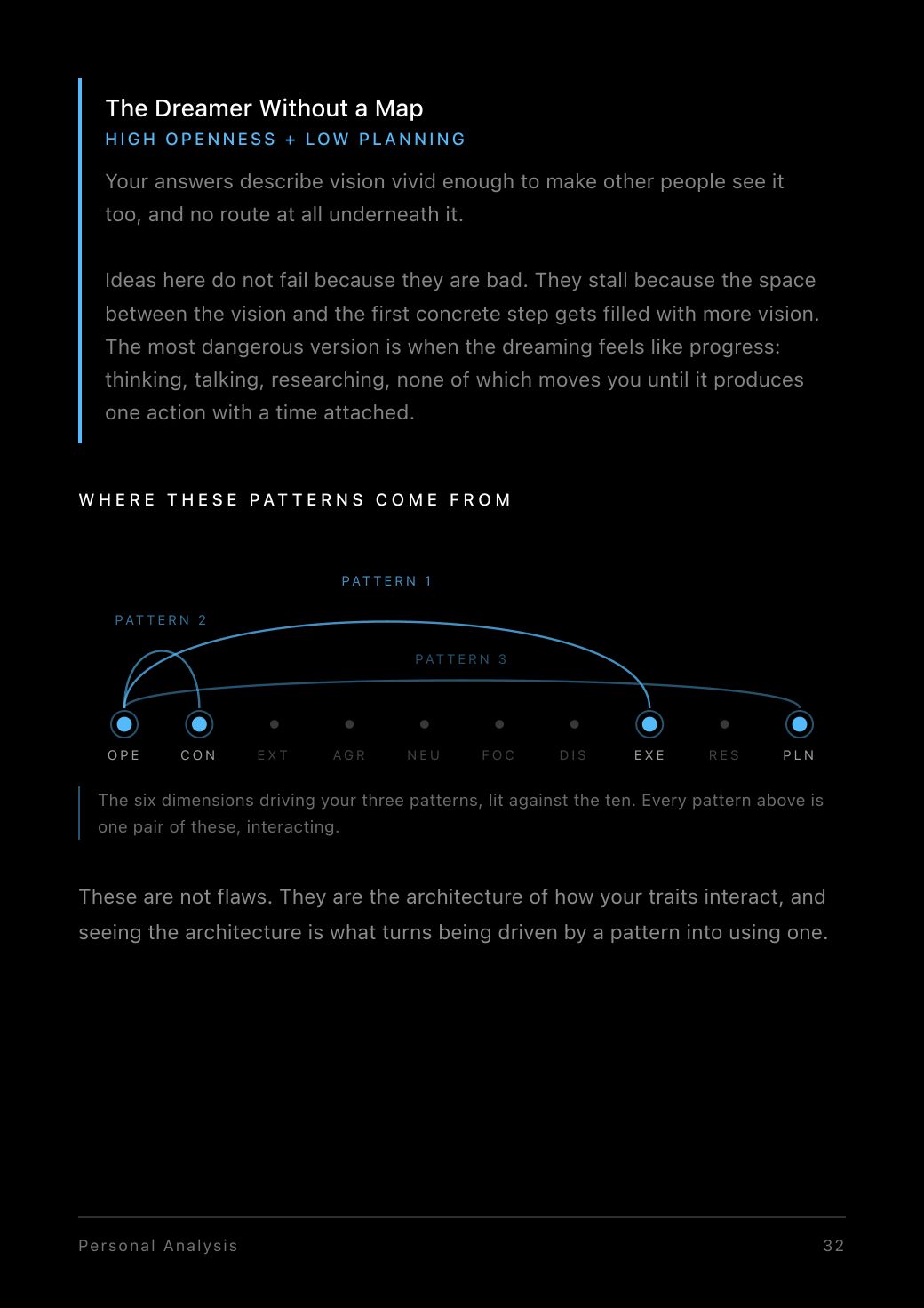
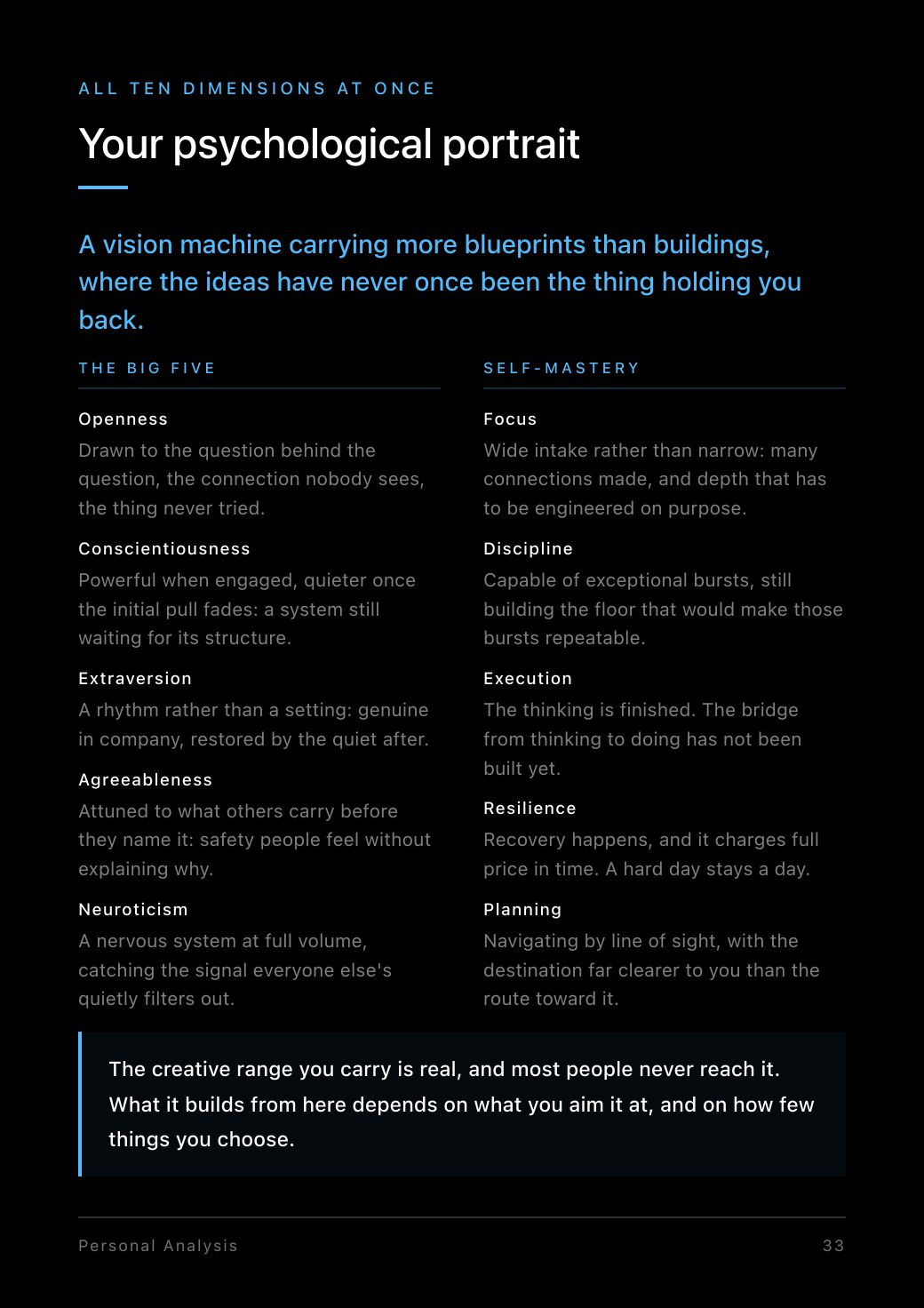
Actual sample pages. Your own documents are shaped by your answers.
We only share testimonials agreed to be shared.
The goal breakdown method is so simple I'm annoyed nobody showed me before. One big goal broken into months then weeks then the one thing I do today. I've used it for my savings my training and a side project.+
Clear practical no motivational fluff. It feels like it was written by someone who actually knows me not by someone selling a mindset.+
The career pages helped me understand why I loved my first job and hated my second even though they looked similar on paper. It was the structure not the work. That insight shaped my next move.+
I'm the person who rolls their eyes at personality tests. A friend sent me hers and dared me. I lost the dare. The analysis was too specific to dismiss and the plan was too practical to ignore.+
The 'adapt or quit' page saved me from abandoning a project I cared about. It gave me a clear way to tell the difference between a bad week and a bad idea. Turns out it was a bad week.+
I run a small agency and I was the bottleneck. The analysis showed me exactly where: I won't delegate anything I can't control. The plan gave me a way to hand over work without losing my mind. My team is happier and so am I.+
My partner read my Personal Analysis over my shoulder and said 'That's you word for word.' Slightly scary mostly useful.+
I gave it to my business partner. We'd been clashing for months. Reading each other's Self Mastery scores explained everything: I'm fast and messy he's slow and precise. We stopped fighting it and started splitting the work that way.+
I'm a student and I thought my grades were about intelligence. My report showed they're about Planning and Focus. I changed how I revise not how hard I revise and my last exams were my best.+
Some of the questions stayed with me for days. By the time the documents arrived I'd already started thinking differently.+
The strangest part was reading things I had never told anyone written back to me from my own answers. It made me realise how much I already knew about myself and never said.+
I'm a manager and I did it to understand why some weeks I'm sharp and others I'm useless. The answer was in how I respond to pressure and how much structure I give myself. The Strategy Blueprint broke it down into a weekly rhythm I could actually follow. My team noticed the difference before I told anyone about it.+
I did a 'free' test online first. Four letters and a list of famous people who share them. Then I did Personal Blueprint. The difference is like a horoscope versus a doctor's report.+
I always called myself resilient because I don't give up. The report made a distinction I'd never considered: not giving up and recovering well are different things. I don't quit but I also never refill the tank. That explained two burnouts.+
Low Planning high Execution. That explains every chaotic project I've ever finished at the last minute. Now I build the structure first and the stress is gone.+
The Big Five part was good. The Self Mastery part was the revelation. Seeing Focus Discipline Execution Resilience and Planning scored separately showed me I'd been blaming the wrong thing for years.+
I've always been the one who looks after everyone else. The analysis was the first thing in years that looked after me. It told me plainly that my kindness has a cost and showed me how to keep giving without running empty.+
My Execution score was low and I was ready to be offended. Then I read the explanation. I don't lack ability I stall at the start because I wait to feel ready. I now start before I feel ready and it's working.+
I've taken every free test online and they all left me with a four letter label and nothing to do with it. Personal Blueprint is different. The Personal Analysis showed me exactly why I start projects with huge energy and drop them three weeks later: high Openness low Discipline and a Planning score that explains everything. Then the Strategy Blueprint gave me a system built around that not against it. Three months in I've finished more than I did all last year.+
I'm a team lead and I've started recommending it to people who report to me not as homework just as something useful. The ones who did it came back with clearer goals and better questions in our one to ones.+
I bought it thinking it was about personality. It turned out to be the most practical business book I've read this year except it was written about me.+
I always procrastinated on admin: invoices tax emails. The analysis explained it wasn't laziness it was low Planning combined with high Openness. Boring tasks with no structure simply never happened. I batch them on one morning now and it's done in two hours.+
It helped me understand my teenage son better indirectly. Once I saw my own Neuroticism score I recognised where he gets some of his worry from. I stopped telling him to 'just relax' and started helping him plan instead.+
The danger zones section is brilliant. It listed four situations where I reliably fall off track. I recognised all four. Now I see them coming and I have a plan ready before they hit.+
My husband is a planner I'm not. We both did it and read each other's reports over dinner. For the first time our differences looked like a system instead of a fight. We now split the house admin by strengths.+
I set the same three goals every January and drop them by February. This year I used the Strategy Blueprint instead of willpower. It's November and two of the three are done. The third is close. The difference wasn't motivation. It was a plan built around the way I actually behave with checkpoints that catch me before I quit.+
I bought it on a whim at 1am. Best impulse purchase I've ever made and I've made a lot of them. The irony is that the report explained my impulse buying too.+
I bought three as Christmas presents: my mum my brother my oldest friend. Every one of them messaged me after reading it. Nothing else I gave started that many real conversations.+
Honestly I think this is amazing. The questions really made me stop and think and the personal analysis felt incredibly accurate almost like it understood me better than I expected. What I liked the most is that it doesn’t just describe your personality but it gives you a clear plan and things you can actually do. Everything was easy to understand the website looks great and the final result was much more detailed and useful than I expected. I can definitely see myself using the blueprint in real life. Really impressive!+The Resilience section was the most honest thing I've read about myself. It didn't soften anything and it didn't leave me there either.+
I thought I was an extravert because I'm good with people. My results showed I'm actually in the middle and that's why big weeks drain me. I finally stopped forcing myself to say yes to everything.+
I was sceptical about paying for a personality test. Then I read the first ten pages and stopped being sceptical. It wasn't telling me who I am. It was showing me patterns I'd never put words to like how I avoid hard conversations by staying busy. The plan that followed was practical specific and honestly a bit confronting. That's what made it work.+
Honestly the best money I've spent on myself in years. Not because it told me anything magical but because it told me the truth clearly and then helped me act on it. That's rarer than it should be.+
Impressively in depth and accurate. A real starting point for a new life with a positive impact I could already feel just from reading the analysis and the plan.+I kept waiting for the generic paragraph that fits everyone. It never came. Every section felt like it was written for one person and that person was me. I've since compared with a friend and her report reads completely differently.+
I used it before deciding whether to change jobs. It didn't make the decision for me but it made it obvious which kind of role I keep burning out in.+
My partner always said I shut down in arguments. The report explained why: under stress I need time before I can talk. Now I say 'give me twenty minutes' instead of going silent. It sounds small. It changed our relationship.+
It's the combinations that got me. Not just 'you're high in this' but what happens when that trait meets another one. High Agreeableness with low Resilience: that's why I say yes and then crash. Nobody had ever connected those dots for me.+
I sent it as a gift with a date set for my sister's birthday morning. The email arrived right when she woke up. She said it felt like a message from me and a mirror at the same time. Lovely touch.+
I'm a nurse on rotating shifts. Most advice assumes a nine to five. The plan worked around my schedule because it was built on how I function not on a standard day. That alone made it worth it.+
Execution and Planning both high Resilience low. I'm the person who builds the perfect plan executes it well and then falls apart at the first setback. Seeing that combination written down was a wake up call. I now plan for the setback as part of the plan.+
What convinced me was how it handles low scores. No shaming no fake positivity. Just: here's what this means here's the cost here's what to do. That's how I'd want a good mentor to talk to me.+
I've always been called 'too sensitive'. The analysis framed it completely differently: I feel accurately I just don't have the structure to carry it. That one sentence changed how I talk about myself.+
What I liked is that the plan doesn't ask me to become a morning person or meditate for an hour. It works with how I already operate and fixes the few things that actually hold me back.+
I was worried it would be another upsell funnel. It isn't. One payment two serious documents and a printable pack. No subscription no follow up sales emails. That alone earned my trust.+
I read the Neuroticism section twice. It explained how I react under stress better than I ever could and then gave me something concrete to do about it.+
I compared my Self Mastery scores with my brother's. Same family completely different profiles. It explained so many old arguments about how we each handle pressure and deadlines.+
I'm not a reader so I was worried about the length. It's written so clearly I read the Personal Analysis in one evening and the Strategy Blueprint over a weekend. No jargon no padding.+
I was stuck between two big decisions for months. The decision section in the Blueprint gave me a way to separate what can't be undone from what can. I made the irreversible part carefully and moved fast on the rest. Both are going well.+
I came for the personality part and stayed for the plan. I've gone back to the Strategy Blueprint every Sunday for ten weeks. It's become the way I review my week and my weeks have never been this clear.+
Discipline was my highest trait and my biggest trap. The analysis showed I'll grind through the wrong task for weeks because stopping feels like failing. Learning that discipline needs direction has saved me a lot of wasted effort.+
There's a page about how I react when things go wrong. I showed it to my best friend and she said 'That's literally what you did last month.' I didn't know whether to be impressed or annoyed.+
My scores surprised me. I expected high Conscientiousness and low Openness. It was the opposite. Reading why I realised I'd built my whole self image around who I was at twenty. It was a little humbling and very freeing.+
Honestly the quality is what got me. It's beautifully designed the questions are thoughtful and the writing is direct without being harsh. It feels like a premium product not a quiz. I've recommended it to three friends already and every one of them came back saying the same thing: 'How does it know?'+
I'm not a planner by nature and the Blueprint knew it. Instead of handing me a complicated system it gave me the minimum structure I need and nothing more. It's the first plan I haven't rebelled against.+
I was building a startup and burning out without knowing why. The report showed high Execution with very low Resilience: I can sprint forever but I never recover. I now schedule recovery the way I schedule meetings. The company is moving faster not slower.+
It changed how I start my day. One protected outcome before messages and meetings. Sounds simple and it is but the Blueprint explained why it matters for someone with my Focus score and that's what made me actually do it.+
These five traits should be taught in schools. Knowing whether you struggle with starting continuing focusing recovering or planning changes everything about how you approach a goal. I learned it at 34. Better late than never.+
The Focus section described my phone habit better than my screen time report does. More importantly it explained why I reach for it: not boredom but avoiding the first uncomfortable minute of hard work.+
I work in sales and I always assumed I was high in Extraversion. I'm not. I'm high in Agreeableness which is why I'm good with clients and terrible at closing. The Blueprint gave me three changes to how I run the last meeting. My close rate went up.+
I bought it in a low moment when I felt stuck and didn't know why. It didn't fix my life overnight and it doesn't pretend to. But it gave me clarity: what I'm strong at where I keep getting in my own way and the first three moves to make. For the first time in a long while I felt like I had a direction instead of just pressure.+
I've just graduated and I had no idea what kind of work suits me. The analysis didn't give me a job title it gave me conditions: autonomy clear deadlines people around me. Now I filter offers by those and the choice is much easier.+
I took it on a Sunday evening half expecting a horoscope with nicer fonts. By Monday morning I'd reread the whole Personal Analysis and booked an hour in my calendar to act on it. It's the most honest description of my habits I've ever read and it came from my own answers not from someone guessing.+
I run a restaurant and my days are chaos. The Blueprint gave me one protected hour each morning before service. That hour is where every good decision this year came from.+
The way it connects Focus and Neuroticism blew my mind. When I'm anxious my focus collapses and I always blamed the focus. The real lever was the anxiety. The plan gave me a two minute reset before deep work and my concentration has noticeably improved.+
I'm a teacher and I did it to understand why some classes exhaust me. The analysis showed I'm high in Agreeableness and take every student's mood home with me. The plan helped me build a boundary at the end of the day. I'm a better teacher for it.+
I took my time with the 100 questions about 15 minutes. Some of them were uncomfortable in a good way. By the end I already felt clearer before reading a single page of the results.+
Worth the money! Eye opening and genuinely helpful for personal growth. I highly recommend it+As a mum of two I lost track of what I actually want. The Strategy Blueprint gave me one small goal for myself each week. Not a life overhaul just one thing that's mine. Six months in I feel like a person again not only a parent.+
The design of the documents is stunning. I genuinely enjoy opening them. That matters more than I expected because I actually go back to them instead of letting them rot in a downloads folder.+
I expected to skim it. Instead I sat with a pen and underlined half of it. It described the way I avoid decisions so precisely that I laughed out loud then went quiet.+
I used the Strategy Blueprint to plan a career change at 41. Breaking it into months and weeks made it feel possible instead of terrifying. Eight months later I've retrained and I'm in my first role in the new field.+
As a founder I needed to know where I sabotage myself. Now I have it in writing and I re read that page every time I feel stuck.+
My fiancé and I did it before the wedding. Not to check compatibility just to understand each other better. It gave us a shared language for stress money and plans. Better than any pre wedding advice we got.+
Every personality test I've done ended with a label and a shrug. The Strategy Blueprint is the part nobody else does. It took my results and turned them into a weekly rhythm I can actually follow.+
The questionnaire itself was a pleasure. Calm beautiful no clutter and the quotes between sections made me slow down and answer honestly. It felt like a premium experience from the first screen.+
I printed the pack and stuck the weekly sheet on the fridge. My kids now ask me if I've 'done my blueprint' yet. Accountability from a seven year old works.+
My wife and I both did it separately. Reading each other's analysis was the most useful conversation we've had in years. I understand now why she needs a plan before she can relax and she understands why I need room to improvise. We argue less and when we do we know what's actually going on.+
I've done personality tests before. This is the first one that described how I actually work.+
My dad is 64 and doesn't do 'personality stuff'. I gifted it anyway. He read the whole thing and asked if we could talk about his Planning score. We've never had a conversation like that before.+
High Discipline low Focus. I do the work every day I just do it scattered across ten things. The analysis put a name on it and the plan fixed it with one rule: one priority before anything else.+
I'm 52 and I thought I knew myself well. The analysis still found two patterns I'd never put into words. One of them explained why I've changed careers three times. I wish I'd had this at thirty.+
I'm an engineer and I'm sceptical by default. I liked that it's built on the Big Five which I'd read about and that it says plainly what it is and isn't. The practical part is what convinced me. The weekly system is better than anything my company's training gave me.+
The section on my blind spots was hard to read. It named the way I explain away my own procrastination almost word for word. But it didn't leave me there. Two pages later it gave me a way to catch myself and for the first time I've actually caught myself.+
What struck me was the tone. It never told me who I am. It showed me what my answers reveal and let me decide what to do with it. That felt respectful and it made me trust everything else in it.+
I liked that the Self Mastery traits are about what you can train not who you are. It felt hopeful without being fluffy. My scores are a starting point and the Blueprint shows what moves them.+
My Resilience score was high and I didn't believe it at first. Then I read how it shows up: I stay calm under pressure but I don't ask for help. The report was right on both counts and the second one is something I'm finally working on.+
Reading my Personal Analysis felt like a conversation with someone who had watched me for years and was finally honest. Not cruel not soft. Just clear. I needed that more than I knew.+
I did it during a confusing time not sure what I wanted next. It didn't hand me an answer but it gave me a map of how I make decisions where I hesitate and why. With that map the answer came on its own a few weeks later.+
I did it after a breakup trying to understand my part in it. It was gentle where it needed to be and honest where it mattered. It helped me see a pattern I'd repeated in three relationships and what to watch for next time.+
Planning came out as my lowest score which surprised nobody who knows me. What surprised me was the advice. It didn't tell me to plan everything. It told me exactly which few things to plan so the rest can stay spontaneous.+
After reading the Strategy Blueprint I deleted four productivity apps. I didn't need more tools. I needed to understand why none of them stuck. Now I use a notebook and the weekly sheet from the pack and it works better than anything I've paid a subscription for.+
I finished the questionnaire at midnight and watched my traits being analysed live. Honestly a bit addictive. Then the documents arrived and they were even better than the animation promised.+
I re read mine every few months. Each time a different section hits harder because I'm in a different place. It's not a one time read. It's a reference I keep coming back to.+
I spend more than this on a dinner out without thinking. This has done more for my year than any dinner ever has. If you're hesitating over the price you're looking at the wrong number.+
Hello I’m the founder of Personal Blueprint. If you’re taking the time to read this I truly hope your Personal Blueprint helps you reach your goals grow and understand yourself better as it did for me. I really mean it. Thank you all.+The early catch signals are my favourite part. When I start skipping the small daily things that's my warning that a bigger slide is coming. I used to notice a month too late. Now I notice in three days.+
My best friend gave it to me as a birthday present with a card that said 'because you keep saying you're stuck'. Cheeky but she was right. It was the most thoughtful gift I got that year.+
I've read a lot about discipline mostly from people who seem to enjoy suffering. This was different. It explained that my discipline is fine when the routine is set up in advance and collapses when every day starts from zero. So I set up the routine. Simple and it finally holds.+
I was sceptical about the Self Mastery traits because they're not a famous model like the Big Five. Then I read them. They describe the things that actually decide whether goals happen and they matched my experience exactly.+
I bought it for my daughter when she started university. She called me after reading her Personal Analysis and said it was the first time she felt understood rather than judged. That was worth far more than the price.+
I did it before a promotion conversation. It helped me name my strengths in plain words instead of vague ones. I walked in knowing what I bring and what I'm working on. I got the role.+
What surprised me most was the Self Mastery part. I always measured myself against people who seemed more disciplined. The analysis showed my Discipline is actually high. My problem is Focus. I was trying to fix the wrong thing for years. Knowing that saved me from another round of apps courses and New Year's resolutions.+
The best part is the reward system. It asks for proof of progress before you celebrate which sounds strict but it's the first time rewards have actually kept me going instead of letting me off the hook.+
I've been in hospitality for fifteen years and I've managed hundreds of people. I wish I'd had this for myself earlier. It explained why I'm calm in a crisis and restless on a quiet Tuesday. I now give my quiet days real projects and they're my most productive.+
Most tests stop at 'you are this'. This one tells you what to do on Monday morning. The Strategy Blueprint turned a vague goal into a weekly plan I've actually kept for two months.+
I bought it for my brother's birthday half as a joke. He called me after reading it and we talked for an hour. Best present I've ever given him.+
I always thought I lacked willpower. The analysis showed me my Discipline is fine my Planning isn't. That one distinction changed how I organise my whole week.+
I've read the big productivity books. They're written for an average reader who doesn't exist. This felt like the same quality of advice but tailored to my scores. Half the generic tips I'd tried never fit me and now I know why.+
I expected a generic report with my name pasted in. Instead I got two documents that read like someone had been watching me for a year. The danger zones section named the exact situations where I fall apart and the plan gave me a way to catch them early. I've printed the pack and it's on my wall.+
My wife and I are opposites in Extraversion. I used to take it personally when she wanted to stay in. Reading both analyses side by side I finally understood she recharges differently. We plan our weekends around both of us now and they're better.+
As a freelancer nobody tells me when I'm drifting. The early warning section became my manager. I check it every Friday and I haven't had a dead month since.+
I've paid for a lot of self help over the years. This is the first thing that didn't tell me to be someone else. It started from who I already am and built from there.+
I've done therapy coaching and a lot of reading. This doesn't replace any of them and it doesn't pretend to. But as a clear honest starting point it's the best thing I've found and I've shared it with my coach.+
Original feedback, presented in our site’s design. Individual experiences vary.
See how understanding yourself can help you move forward.
Your goal
An example of how to apply your results. Your own documents are shaped by your questionnaire answers.
Build my plan for this goalChoose another goalSee how understanding yourself can help you move forward.
Plan balanced meals
Cook more at home
Keep a sleep routine
Reduce late night snacking
Make time for rest
Build a morning routine
Prepare meals ahead
Keep regular mealtimes
Follow a wellbeing routine
Notice the patterns behind your everyday choices and what makes supportive routines easier or harder to maintain.
Turn a wellbeing goal into manageable routines, with clear cues, regular reviews, and room to adjust.
Train consistently
Return to the gym
Start exercising
Finish a programme
Move more each day
Build an active routine
Stay consistent at home
Prepare for an event
Restart after a break
Recognise how your patterns affect starting, consistency, and recovery after a missed session.
Choose a realistic training goal, schedule small actions, and plan how to return after a missed day.
Express my needs
Set clearer boundaries
Listen more carefully
Handle disagreements
Make time for loved ones
Respond less impulsively
Have a difficult conversation
Build new connections
Notice relationship patterns
Understand your own social tendencies and emotional responses so you can recognise what you bring to interactions.
Choose a behaviour to practise, prepare for difficult moments, and review what helps you communicate more clearly.
Build a morning routine
Scroll less
Stop postponing tasks
Read regularly
Keep a bedtime routine
Make time for myself
Replace an unhelpful habit
Keep a weekly reset
Restart after missed days
Identify what supports your follow through and where distraction, inconsistency, or setbacks interrupt your routines.
Start with one repeatable action, give it a place in your day, and build a practical restart plan.
Choose my next career step
Finish an important project
Start a side project
Prepare for a job search
Learn a work skill
Organise my workload
Speak up at work
Build a professional routine
Make time for meaningful work
Recognise strengths, working tendencies, and blind spots that may shape how you approach professional challenges.
Define a concrete work goal, break it into milestones, and give your next action a place in the week.
Finish what I start
Reduce digital distractions
Choose daily priorities
Start difficult tasks
Make time for deep work
Stop switching tasks
Plan my week
Keep a realistic task list
Protect time for important work
Understand how your attention, planning, and execution patterns affect the gap between effort and completed work.
Choose one priority, protect a working block, reduce likely friction, and review what actually gets finished.
Build a saving habit
Set a savings target
Track everyday spending
Reduce impulse purchases
Plan a weekly budget
Save for a specific purchase
Review subscriptions
Keep a money check in
Follow a spending plan
Reflect on tendencies behind impulsive choices, planning, and consistency that may influence your money habits.
Break a money goal into realistic amounts and repeatable actions, then track and review your own plan.
Learn a new skill
Finish an online course
Practise a language
Read with a purpose
Start a creative project
Finish a creative project
Build a practice routine
Make time for new ideas
Share work I keep postponing
Explore how curiosity, attention, and follow through shape the way you learn, practise, and develop ideas.
Choose a skill or project, define what progress looks like, and build small practice sessions into your week.
Navigate a life change
Restart a stalled goal
Regain direction
Return after disappointment
Adjust an unrealistic plan
Rebuild a daily routine
Learn from a failed attempt
Take a first step again
Keep going after a setback
Recognise how you tend to respond to uncertainty, pressure, and setbacks, including what may slow your return.
Identify what remains within your control, choose a manageable next step, and review the plan as circumstances change.
Recognise where you are. See a different way forward.
Bring your strengths and obstacles into focus. Choose a meaningful priority, then turn it into a first step you can actually take.
Connect your traits with familiar reactions. Recognise what you need, what drains you and what helps you work at your best.
Recognise where your tendencies give you an advantage. Put those strengths to work and give your blind spots practical support.
Build a smaller version for difficult days and a clear way back. Keep what you have learned instead of abandoning the whole plan.
Recognise the pattern behind your reaction. Prepare a different next move and practise it in the situations that usually pull you back.
Understand what influences your choices. Clarify what matters, choose a workable next step and learn from the result instead of waiting for certainty.
Recognise what pulls your attention away. Choose one meaningful action, give it a clear time and reduce the friction around starting.
Separate what happened from what you are worth. Review the obstacle, keep the useful lesson and decide what to change next time.
Track the actions you take and review what changes. See what is working, adjust what is not and give your effort useful feedback.
Return to your insights, review your choices and choose your next step. Develop a repeatable way to move forward as your goals change.
From understanding yourself to building your way forward.
Answer 100 questions to reveal how you think, feel and approach daily life.
Discover your strengths, blind spots and the patterns that shape your life.
Turn personal insight into practical strategies for your goals and habits.
Choose one meaningful priority and a clear direction that works for you.
Use your tools and printables to turn that priority into a practical action.
Review what works, adjust your approach and keep building your way forward.
“The most useful person to understand is yourself.”
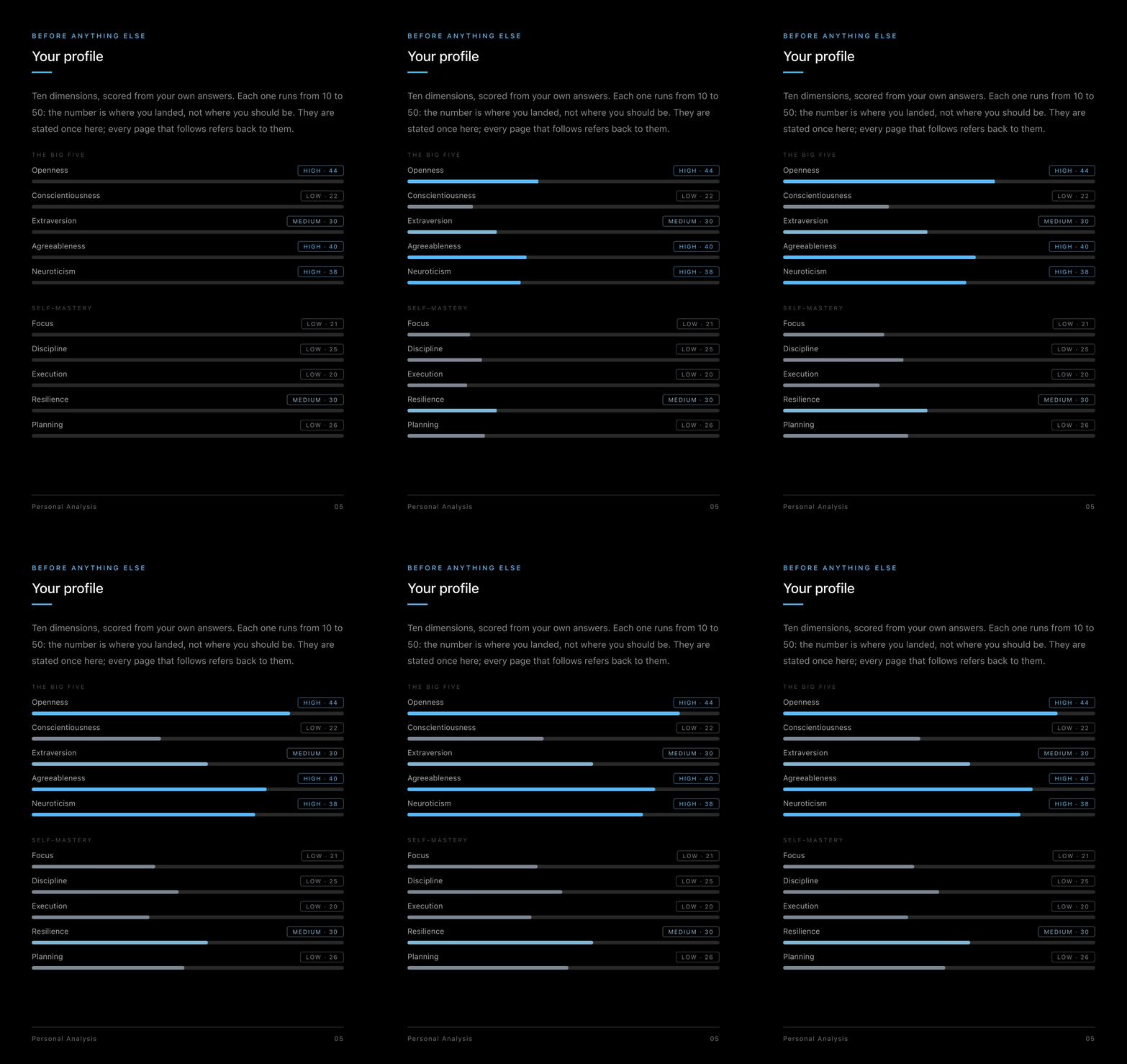
Five established dimensions used in personality research to explore the tendencies that shape your everyday life.
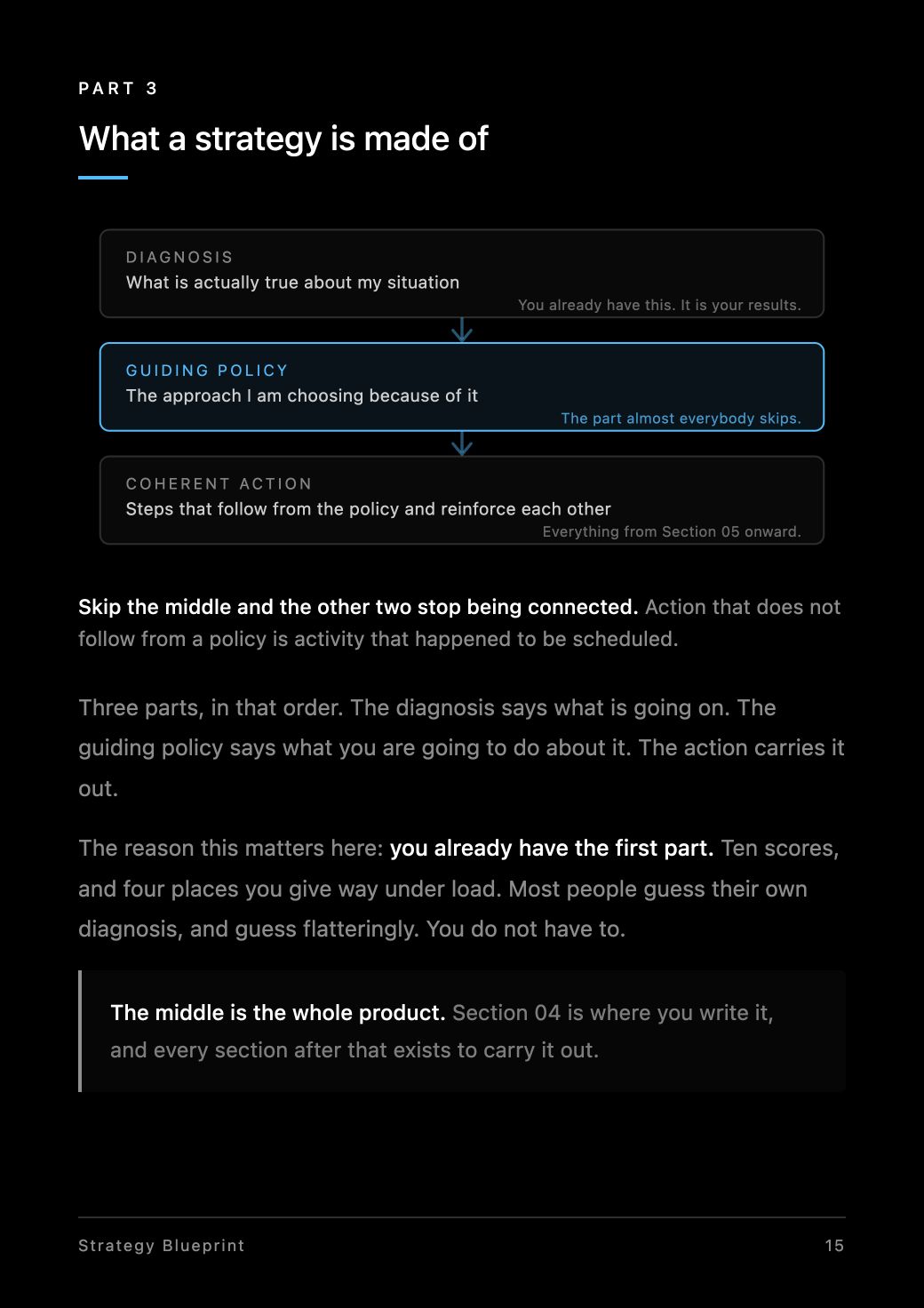
Example results. Your profile will reflect your answers.
Openness measures your interest in new ideas, imagination, beauty, and unfamiliar experiences. It reflects whether you are drawn to exploring possibilities or prefer what is familiar, practical, and proven.
Conscientiousness measures how reliably you organise, plan, and follow through. It reflects your attention to order, responsibility, and detail, and how consistently you work towards what you set out to do.
Extraversion measures how much social interaction and stimulation you seek. It reflects how readily you move towards people, attention, and activity, or prefer quieter settings and time to yourself.
Agreeableness measures how you balance other people’s needs with your own. It reflects your tendency towards trust, cooperation, and compassion, and how directly you assert yourself when interests or opinions differ.
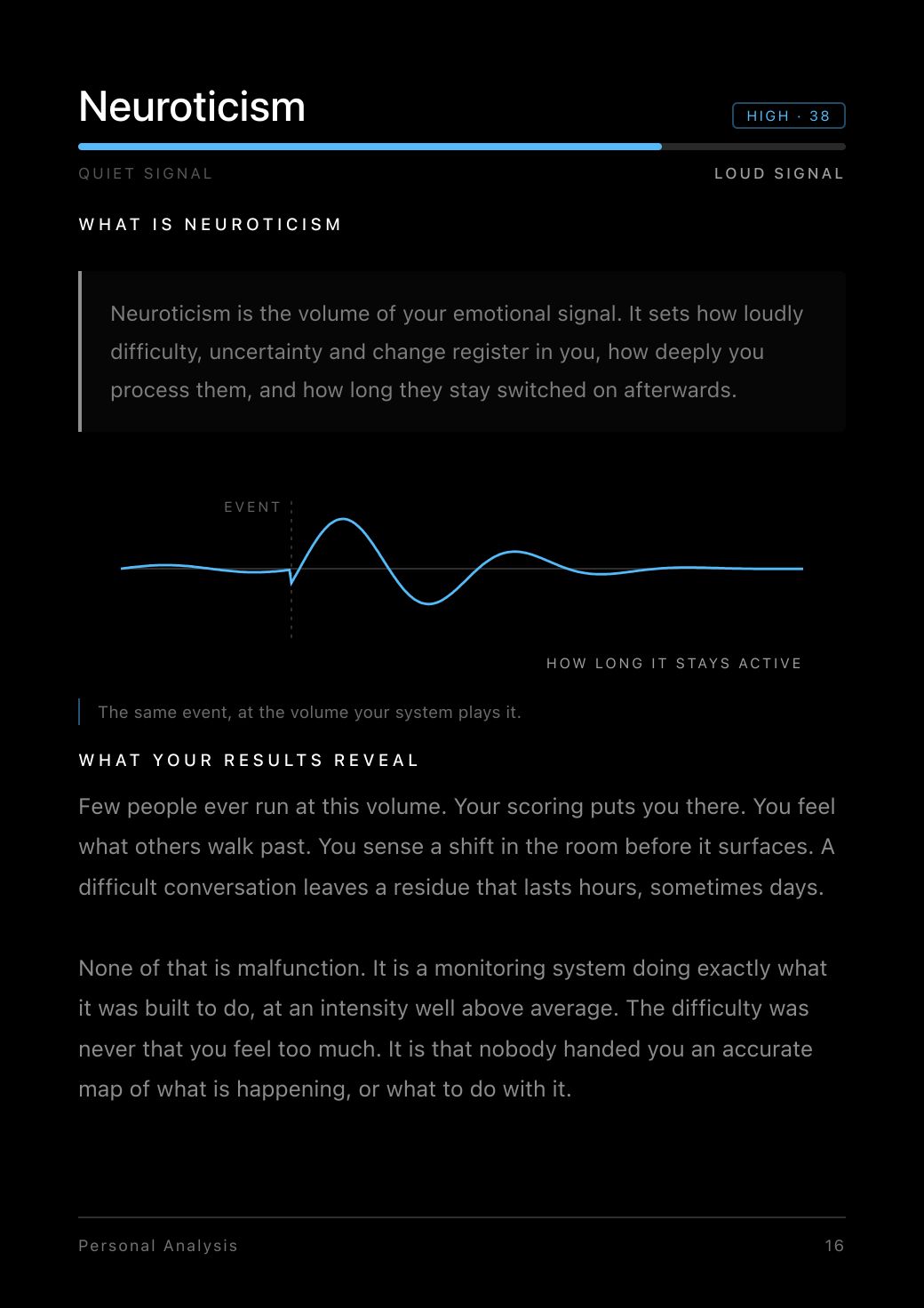
Neuroticism measures how strongly you experience stress, worry, and emotional difficulty. It reflects how readily pressure affects you and how long those feelings tend to remain after a setback.
Five practical dimensions that reveal how you turn intentions into action, helping you build consistency and adapt.
Example results. Your profile will reflect your answers.
Focus explores your ability to direct attention deliberately and keep it on one task despite distractions. It reflects how readily you settle into concentrated work and how consistently you sustain it.
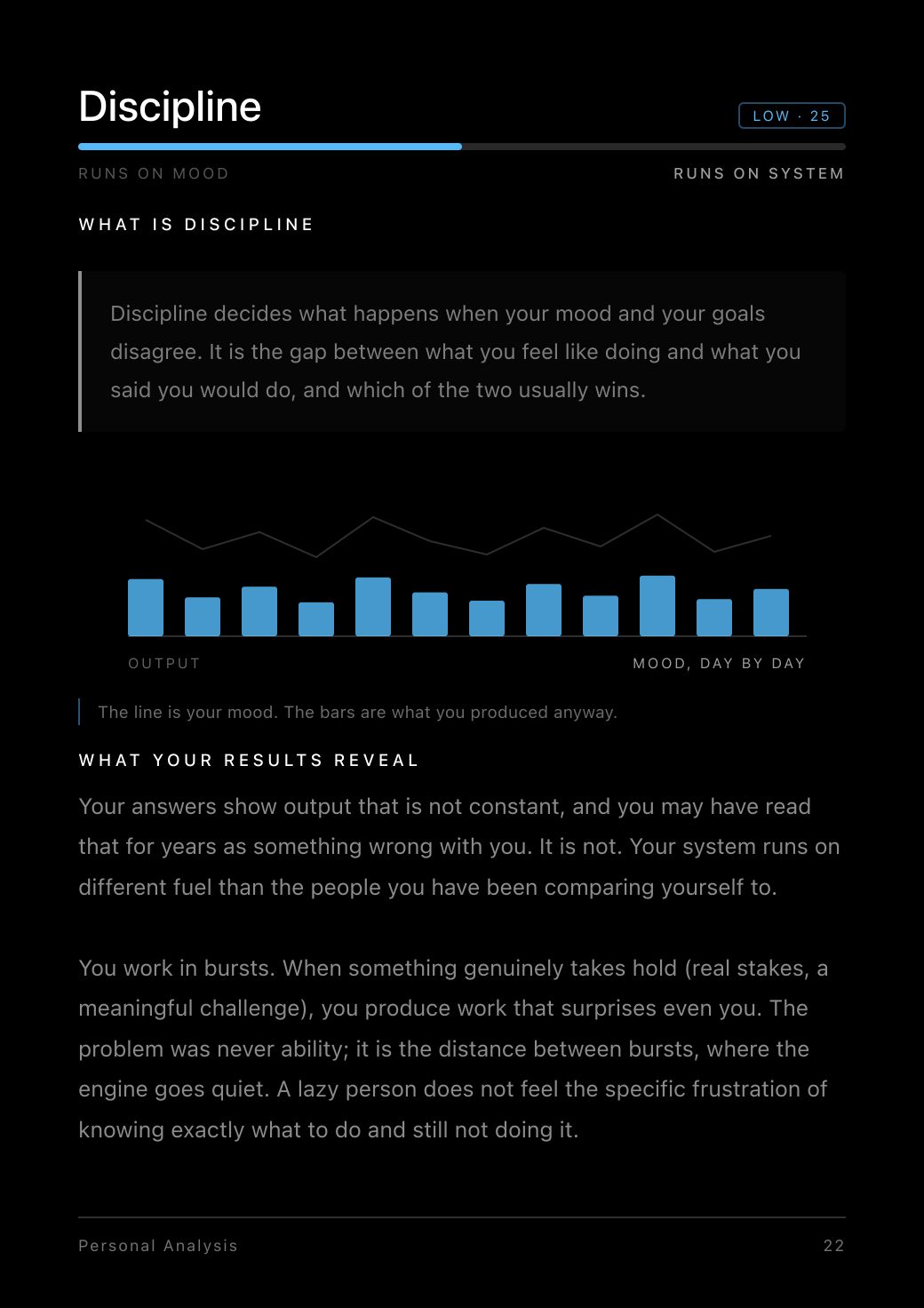
Discipline explores how consistently you follow through when motivation or mood changes. It reflects your ability to choose actions that support your goals, even when something easier feels more appealing.
Execution explores how readily you move from a decision to a concrete first step. It reflects whether intentions become action and how independently you get started rather than keep postponing.
Resilience explores how you respond after a setback. It reflects your ability to regain perspective, adapt your approach, and return to what matters after disappointment or difficulty.
Planning explores how you turn a goal into a workable route. It reflects how far ahead you think, how clearly you define steps, and how you adapt when circumstances change.
The best investment is the one you make
for yourself.
Everything inside your Personal Blueprint.
One payment. No subscription.
Start your Personal Blueprint nowEverything inside your Personal Blueprint.
One payment. No subscription.
Purchase Personal Blueprint gift cardPersonal insights deserve a private place.

Delivering your Blueprint requires service providers, including Render, Stripe, Resend, and Airtable. Their roles and your rights are explained in the privacy policy.
Clear answers. A confident next step.

For people who want to understand their patterns and take a more considered approach to personal growth. You do not need to have everything figured out before starting.
No. Your Personal Analysis gives you a clearer starting point. Your Strategy Blueprint helps you translate that understanding into priorities and practical next steps.
It combines the established Big Five personality framework with Personal Blueprint’s own Self Mastery dimensions: focus, discipline, execution, resilience, and planning. They are distinct approaches with different research foundations.
Allow around 10 to 20 minutes for 100 questions. Answer honestly rather than choosing who you wish you were. Explore your documents at your own pace afterwards.
Yes. The sample pages above show the format of your Personal Analysis and Strategy Blueprint. Your own documents are shaped by your answers.
Use the private access link sent to your email to open your questionnaire. Keep the email so you can return to your Personal Blueprint.
After completing your questionnaire, access your Personal Analysis, Strategy Blueprint, and printables through your personal link. You can read online or save your documents as PDFs to print.
Yes. The purchase includes permanent access through your personal link. Keep that link private and save the email somewhere you can find it.
Start with your Personal Analysis to understand your profile. Then choose one priority in your Strategy Blueprint and use a printable to turn it into a manageable next step.
Check your spam or junk folder first. If you still need help, email contact@personalblueprint.net from the address you used for your purchase.

Understand your strengths and patterns. Turn that insight into a practical plan for your goals. Build the future you desire.
One payment. No subscription. Yours to revisit.